Part 1: The Great March Reset – Clearing the Fog with Aromatherapy

Introduction
Did your January resolutions hit a wall somewhere around mid-February?
If so, welcome to the "March Slump." You aren’t alone. By this time of year, the initial adrenaline of a "New Year" has faded; January lasted forever, February was gone in a blink, the weather is often grey, and our brains are tired of the uphill climb. It’s the time of year when we don't just feel unmotivated—we feel foggy.
But before you write off your goals for the year, we’re going to use a bit of sensory science to hit the "Reset" button.
A Quick Safety Note
It’s important to point out a few safety notes in mind and ensure that they are followed mindfully.
Some essential oils such as Rosemary and Eucalyptus are reported to have properties that can trigger those living with Epilepsy, so caution is very important and avoid or speak to your doctor if you are unsure.
Where possible alternative essential oils are suggested for use if you’re unable to use Rosemary, but do NOT risk using any ingredient if you are unsure.
Essential oils must never be used on your skin without being diluted in a carrier oil, and must never be ingested or taken internally. In the event that essential oils get onto your skin, wash off immediately with warm water and your usual soap and monitor for any affects. If in the eyes, rinse a few times with milk and seek medical advice immediately.
This article is for educational purposes only and is NOT a substitute for medical advice or treatment. Always be mindful of safety with everything you make, and remember:
If in doubt, Check it out.
The Science of the "Scent Break"
Our sense of smell is the only one of our five senses with a direct line to the limbic system—the part of the brain responsible for emotion and memory. To put it technically, receptors within the nasal cavity collects smell particles caught in the nose hairs, sending signals to the brain in order to process and recognise them. This means that this amazing part of your brain works without your conscious effort, transporting you back to your most precious memories in an instant. This also means that fragrance can dictate your body’s responses depending on the affect you want to achieve. So when you inhale a sharp, clarifying essential oil, you aren't just smelling a plant; you are sending a biological "wake-up call" to your brain.
By using specific oils in early March, we can interrupt procrastination loops and signal to our nervous system that it’s time to move from winter hibernation into spring clarity.
The "Big Three" Oils for Mental Clarity
For this reset, we are focusing on oils that act like a cold splash of water to the face:
Lemon (Citrus Limon): The ultimate "clean slate" scent. It reduces errors and boosts mood.
Rosemary (Rosmarinus Officinalis): Known since ancient times as the herb for "remembrance." It’s scientifically proven to aid cognitive function and concentration.
Peppermint (Mentha Piperita): Provides that instant "zing" of alertness by increasing oxygen flow to the brain.
Because of the high amounts of 1,8-Cineole (McCready and Moss, 2013) compound within Rosemary essential oil, it poses a high risk for those living with epilepsy to trigger their seizures. Its best to avoid Rosemary essential oil completely, as inhaling the fragrance is shown to also have an affect.
An alternative essential oil to use instead of Rosemary would be Bergamot FCF (Citrus bergamia).
The "Focus Wand" (Portable Inhaler)
The "Focus Wand" is a portable nasal inhaler you can keep in your pocket or desk drawer. It’s your secret weapon for when you’re staring at a screen and your eyes start to glaze over.
What You’ll Need:
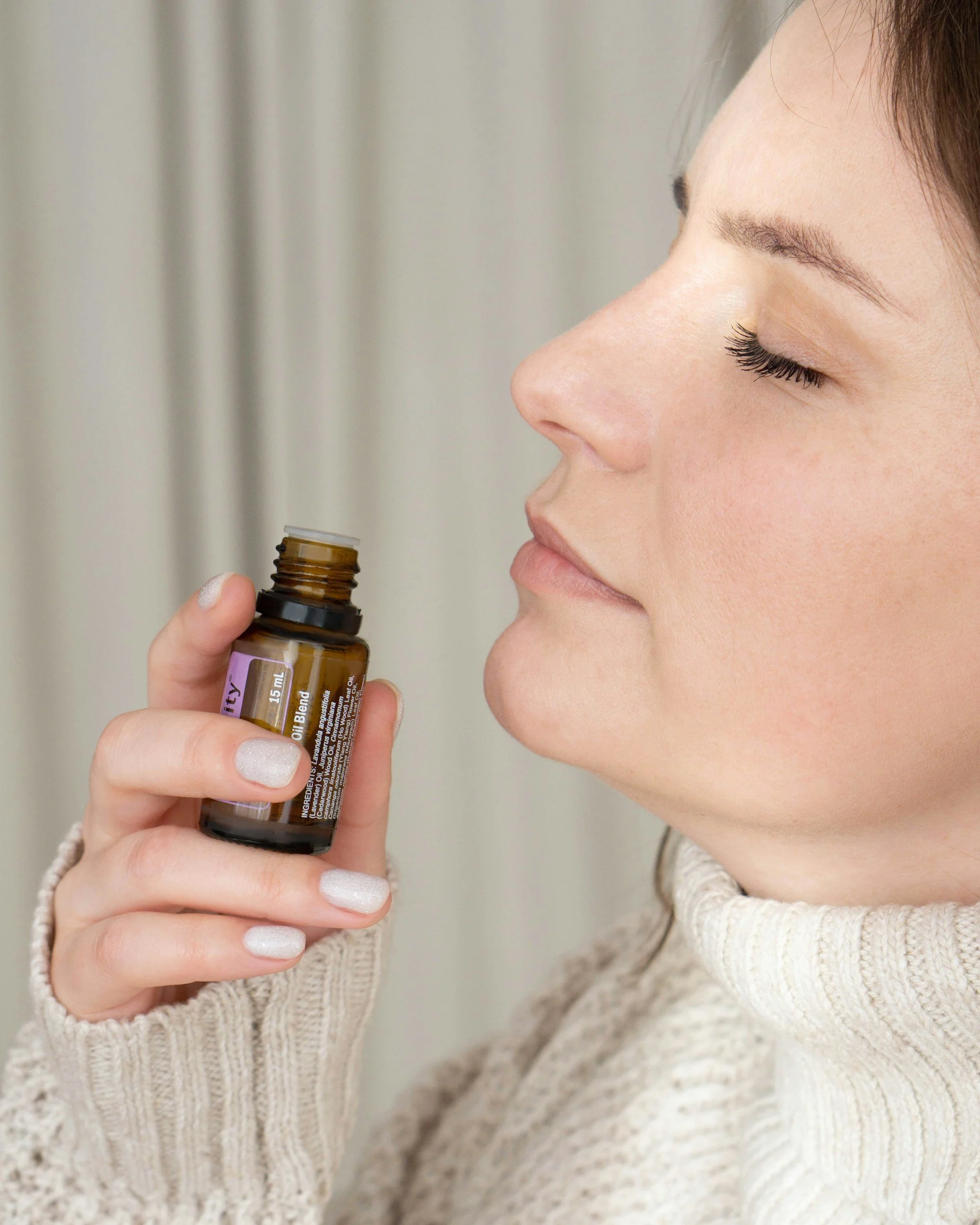
1 Blank Essential Oil Inhaler (a plastic or glass tube with a cotton wick. You can even use a cotton wool ball in a small glass jar.).
The "Reset" Blend:
4 drops Lemon
3 drops Rosemary or Bergamot
2 drops Peppermint
A pair of gloves (rubber gloves, or marigolds)
Instructions:
Place the cotton wick (or cotton wool) in a small glass bowl.
Drip your essential oils directly onto the wick until it’s saturated.
Use tweezers to pop the wick into the inhaler tube (or cotton wool into the jar).
Snap the base cap on tightly.
How to use it: Whenever you feel your focus drifting, take three deep, slow breaths from the inhaler. Close your eyes and visualize the "fog" lifting.
The best part is that you can reuse the inhaler (jar). Whenever the fragrance fades, you can refresh it using the same steps above.
Make sure to keep your inhalers away from small children and pets. These essential oils are undiluted because they are not intended for use on the skin. It’s best to avoid them from being chewed on by either children or pets, and also because the essential oils are particularly strong, it may cause some discomfort to their nose and/or eyes.
Moving Forward
This week, give yourself permission to let go of the February guilt. We aren't worried about what didn't get done last month; we’re focused on the clarity we’re building right now.
Next week, in Part 2, we’ll talk about how to "anchor" this new focus into a productive flow state using passive diffusion!
References and Further Reading
If you want to look into any of the essential oils discussed in this article, here are the articles and pages I read.
🍋 The Power of Lemon
Benefits of Lemon Essential Oil:
Gonçalves, S. et al. (2025). “A systematic review of the therapeutic properties of lemon essential oil” Journal: Advances in Integrative Medicine, Volume 12, Issue 3, September 2025, 100433
Watson, K. (2023). “What You Need to Know About Lemon Essential Oil” [online] at: Lemon Essential Oil: Benefits, Side Effects, How to Use, and More
🌿 The "1,8-Cineole" Connection (Rosemary and the Brain)
McCready, J. and Moss, M. (2013). “Rosemary aroma may help you remember to do things” [online] at: Rosemary aroma may help you remember to do things | Northumbria University, Newcastle
🧠 The Synergy of Rosemary & Peppermint
Tisserand, H. (2026) “Essential Oils and Cognitive Function” [online] at: Essential Oils and Cognitive Function - Tisserand Institute
Tisserand, R. (2026) “Cognitive Health and Essential Oil Research: an Interview with Mark Moss” [online] at: Cognitive Health and Essential Oil Research: an Interview with Mark Moss - Tisserand Institute