The Mindful Morning: Scenting Your Transition Into the Digital World
Introduction
We’ve all done it: the alarm goes off, and before our feet even touch the floor, we are already scrolling. In an instant, our brain is flooded with world news, work emails, and social comparisons. We haven’t even taken our first sip of coffee, yet we’ve already handed over our peace of mind to a glowing screen.
The morning is the most vulnerable time for your attention. When you wake up, your brain is in a "theta" state—highly creative, intuitive, and suggestible. By diving straight into the digital world, you are essentially letting the internet program your mood for the day.
Stepping into the day shouldn’t feel like a collision.
In this second part of our "Beyond the Screen" series, we’re moving away from the unwind and focusing on the arrival. We’ll explore how to use "activating" aromatherapy to build a protective mental barrier—a sensory moat, if you will—that allows you to wake up fully before you plug in. It’s time to stop the morning scroll and start a morning ritual that belongs entirely to you.
You can find Part one here.
A Quick Safety Note
As said in Part 1 of this series, a few safety notes are important to keep in mind and follow.
Essential oils are not the same as fragrance oils. Some people can develop sensitivities or allergies to oils, so a patch is very important.

To conduct a patch test, place a drop or small amount of the finished product onto the inside of the elbow on one arm or the inside of the knee. Leave for up to 24 hours, unless a reaction occurs. The skin there is sensitive and if an allergy is present the area could become itchy, red or blotchy or a combination of these. If irritation does occur, wash the area with warm clean water and do not use the product again. Seek medical attention if you find that irritation continues or if your symptoms get worse. But do NOT risk using an ingredient if you are unsure.
Essential oils must never be used without being diluted in a carrier oil, and must never be ingested or taken internally.
Some essential oils such as Basil, Rosemary and Eucalyptus are reported to have properties that can trigger those living with Epilepsy, so caution is very important and avoid or speak to your doctor if you are unsure.
This article is for educational purposes only and is NOT a substitute for medical advice or treatment. Always be mindful of safety with everything you make.
The Morning Awakening: Scents to Clear the "Sleep Fog"
When you first wake up, your brain is like a blank canvas. Instead of immediate digital input, we use top-note essential oils—these are the scents that hit your nose quickly and dissipate fast, providing an instant "jolt" of clarity to the nervous system.
1. Peppermint: The Cognitive Ignition
Peppermint is the ultimate "wake-up" oil. It contains menthol, which has been shown to increase alertness and improve memory performance. Inhaling Peppermint in the morning acts as a natural "start" button, clearing the sinuses and sharpening your focus so you don't feel the need to reach for your phone just to feel "awake."
2. Lemon: The Sunlight in a Bottle
Citrus oils are sunshine for the brain. Lemon, specifically, is known for its ability to reduce errors and improve concentration. Its bright, zesty aroma helps dissipate that heavy, sluggish feeling we often try to "cure" with a scroll through a newsfeed. It encourages a positive outlook before you encounter any potentially stressful digital content.
3. Rosemary: The Oil of Remembrance
If your morning goal is to get straight into deep work or creative projects, Rosemary is your best friend. It’s been linked to increased levels of 1,8-cineole in the blood, which correlates with higher cognitive performance. It helps you remember your own goals for the day before you get side-tracked by everyone else's.
4. Grapefruit: The Mood Guard
Grapefruit has an incredibly uplifting, energizing scent that helps combat "morning grumpiness." It’s a great protective oil; it helps foster a sense of confidence and "can-do" energy, making you feel like the master of your technology, rather than a slave to it.
The Morning Moat: Energizing Diffuser Recipes
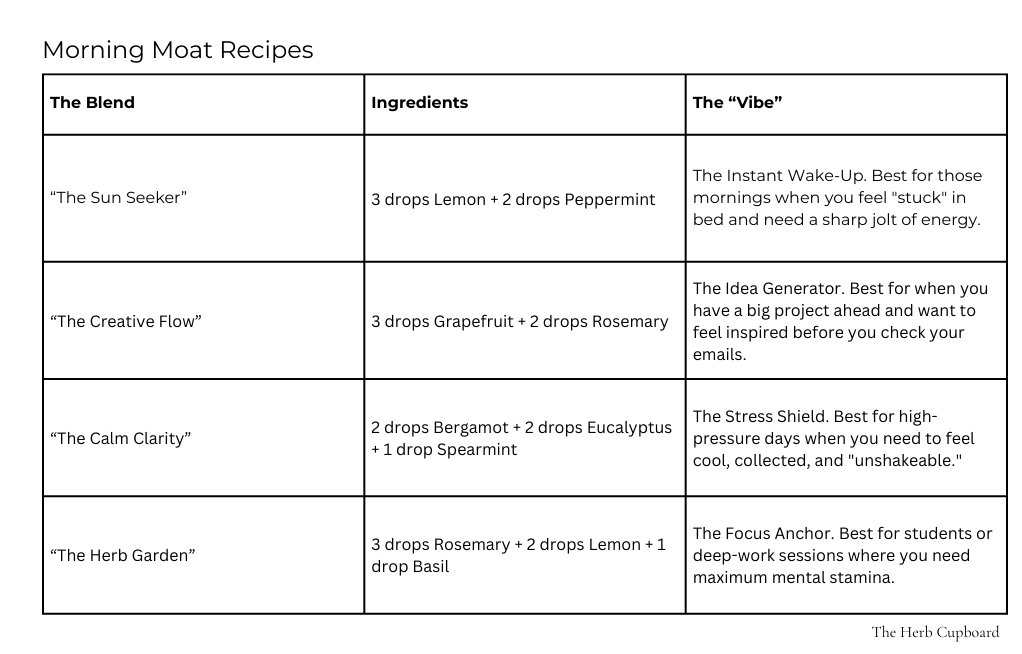
To build your sensory buffer, choose the blend that matches how you want your day to feel. Start your diffuser during Step 2 (Set the Atmosphere) of your ritual to signal to your brain that it’s time to shift from sleep to focused action.
💡 The "Pre-Plug" Application
To make this work, you have to use the oils before you touch your device.
The Shower Steam: Put two drops of Lemon or Peppermint on the floor of your shower (away from the direct stream). The warm steam will carry the scent into your lungs, waking up your brain before you've even seen a screen.
The Morning Cup: While your tea or coffee is brewing, put a drop of Rosemary on a tissue and take three deep breaths. Set one intention for your day that has nothing to do with an app.
How to Tie These into Your Ritual
To get the most out of these recipes, don't just "set and forget" your diffuser. Make it an active part of your Morning Moat:
During Step 2: Set the Atmosphere
While your diffuser begins to mist, stand over it for three deep breaths. Let the citrus notes (Lemon/Grapefruit) hit your olfactory system first—this "reboots" your mood and stops the craving for a dopamine hit from your phone.
During Step 3: The Tactile Transition
As you move through your stretches or drink your water, notice how the scent changes the "texture" of the room. Does the Rosemary make the air feel crisper? Does the Peppermint make the room feel cooler? This mindful observation keeps you in your body and away from the digital "cloud."
During Step 4: The Intentional Shield
When you sit down to write your "One Big Thing," use the scent as a mental bookmark. Every time you catch a whiff of that specific morning blend throughout the next hour, let it remind you of the intention you wrote down. It acts as a sensory anchor that keeps you on track even after you've logged in.

💡 Pro-Tip: The "Moat" Mist
If you don't have a diffuser in every room, you can make a Morning Moat Room Spray.
Fill a 60ml/2oz glass spray bottle with distilled water and a splash of witch hazel.
Add 10-15 drops of your favourite blend from the table above.
Mist your workspace before you sit down to start your digital day.
The "No-Phone Zone" Morning Ritual: A 10-Minute Sensory Buffer
The goal of this ritual is to build a "mental moat" around your morning. By the time you finally pick up your phone, you will be so grounded in your own body and intentions that the digital world won't be able to "pull" at you as strongly.
Minutes 1-3: The Scented Wake-Up
Before you even leave your bedroom, engage your sense of smell.
The Action: Keep an energizing rollerball (like Peppermint or Grapefruit) on your nightstand. Instead of grabbing your phone to check the time, grab the oil.
The Goal: Apply it to your palms, cup them over your nose, and take five slow, deep breaths. This floods the brain with oxygen and "wakes up" the limbic system, signalling that the day has begun—no screen required.
Minutes 4-7: The Tactile Grounding
Now, move your body. Digital life happens in our heads, so we need to move the energy down into our limbs.
The Action: Perform a "Three-Point Check-In."
Feet: Stand on the floor and feel the texture of the rug or wood.
Hands: Splash cool water on your face or hold a warm mug.
Breath: Notice the temperature of the air as it enters your nose.
The Scent: If you have a diffuser in your kitchen or bathroom, turn it on now with the "Morning Sunlight" blend (2 drops Lemon + 2 drops Peppermint).
Minutes 8-10: The Intentional Shield
Before you open a single app, decide what you want from the day.
The Action: Jot down just one thing you want to accomplish today that brings you joy.
The Goal: By writing this down while surrounded by the scent of Rosemary (the oil of remembrance), you are "locking in" your priority. You are deciding that your goals are more important than the notifications waiting for you.

The "First Login" Strategy
When it finally is time to plug in—whether for work or catching up—do it with a specific scent nearby.
Try this: Keep a small "Focus Stone" or a cotton ball with a drop of Eucalyptus next to your computer. As you open your browser, take one deep breath. This serves as a reminder: "I am using this tool; this tool is not using me."
Conclusion: Becoming the Architect of Your Attention
The first hour of your day is the most sacred. When you reclaim it from the digital world, you aren't just "avoiding distractions"—you are training your brain to prioritize your own peace over the demands of the internet. By using the bright, sharp notes of aromatherapy to anchor your morning, you transform those first ten minutes into a protective shield that lasts all day.
Remember: you don’t have to be a monk to be mindful. You just have to be intentional. You don't need a two-hour meditation practice; you just need a deep breath of Peppermint, a moment of tactile grounding, and the courage to let your notifications wait while you find your footing.
The 3-Day Morning Moat Challenge
I want to challenge you to try this "Sensory Buffer" for just the next three mornings.
Phone in a drawer until after your first cup of tea.
Diffuse a citrus blend the moment you walk into the kitchen.
Write one intention before you open your email.
Notice how your energy feels at noon. Do you feel more focused? Less reactive? More "anchored" in your own life?
Let’s Connect!
What is the first thing you usually do when you wake up? If you’re brave enough to admit it’s the "morning scroll," tell me in the comments! Let's hold each other accountable as we build our morning moats together.
[Don't forget to grab the Morning Moat Ritual Worksheet here to help you plan your scents!]